
AI Portrait Robot Software: Why It Matters More Than the Arm
Buy a robotic drawing arm and you will be shown torque figures, reach and repeatability. None of that is what fails at 11pm with forty people queuing.
What fails is the software: the face analysis that loses the likeness under coloured event lighting, the queue logic that jams after the twentieth guest, the retry that never comes when a drawing aborts halfway. The arm draws. The software decides what it draws and whether it keeps drawing.
This page compares the two ways of getting that software: the one bundled with whatever robot you bought, and PICTIAX, which is licensed separately and runs on multiple arms.
The Two Models You Are Choosing Between
Bundled vendor software. The robot arrives with whatever the manufacturer wrote. It works on their arm and nowhere else, the roadmap is theirs, and if you later buy a second robot from a different maker you start again.
Licensed, hardware-agnostic software. You buy the arm from whoever builds the best one at the price you want, and license the software separately. The same operator workflow runs across every unit you own, whatever the badge on the arm.
The second model is what PICTIAX sells: an AI software licence plus PICTICOINS, the credits consumed each time a portrait is drawn.
What Actually Breaks at a Live Event
Six hours, a queue that does not stop, lighting nobody planned, and guests who move. These are the failure points, in the order they usually bite:
- Identity loss. The portrait is technically fine and does not look like the person. This is face analysis under bad light, and it is the complaint that ends a booking.
- Queue collapse. Throughput holds for twenty guests and then the gaps between drawings grow.
- No graceful retry. A drawing aborts and the operator has to restart the machine in front of a queue.
- Line quality. An image converted to lines without accounting for how an arm physically draws produces something that looks like a plotter output, not a portrait.
- Branding as an afterthought. The client wants their logo on every piece and it has to look designed, not stamped on.
What PICTIAX Puts Against Each of Those
PICTIAX is built as a stack rather than a single feature, and each part maps to one of the failures above:
- Face analysis: real-time face recognition that preserves identity, which is the whole game.
- Line generation: image-to-line conversion optimised for how a robot actually executes a stroke.
- Styles: portrait, caricature and branded styles.
- Event logic: queue logic, retries and fallbacks, the part that decides whether hour six looks like hour one.
- Branding layer: logo and campaign integration for brand work.
- Hybrid AI: on-device AI alongside cloud AI, so a venue with bad connectivity does not end the night.
How the Money Works
Bundled software is usually priced into the robot. It looks free, and its real cost shows up as lock-in: your second unit has to come from the same manufacturer or you run two different workflows.
PICTIAX separates the two. You take a licence, annual or lifetime, and then top up PICTICOINS, with one consumed per portrait drawn. That means the software cost scales with how much you actually work: a quiet month is cheap and a busy one is paid for by the events themselves.
Which model suits you depends on volume and on whether you plan to own more than one robot. Current licence and PICTICOIN pricing is on pictiax.com, and it is the number to ask for before you commit to any arm.
If You Are Buying the Robot Too
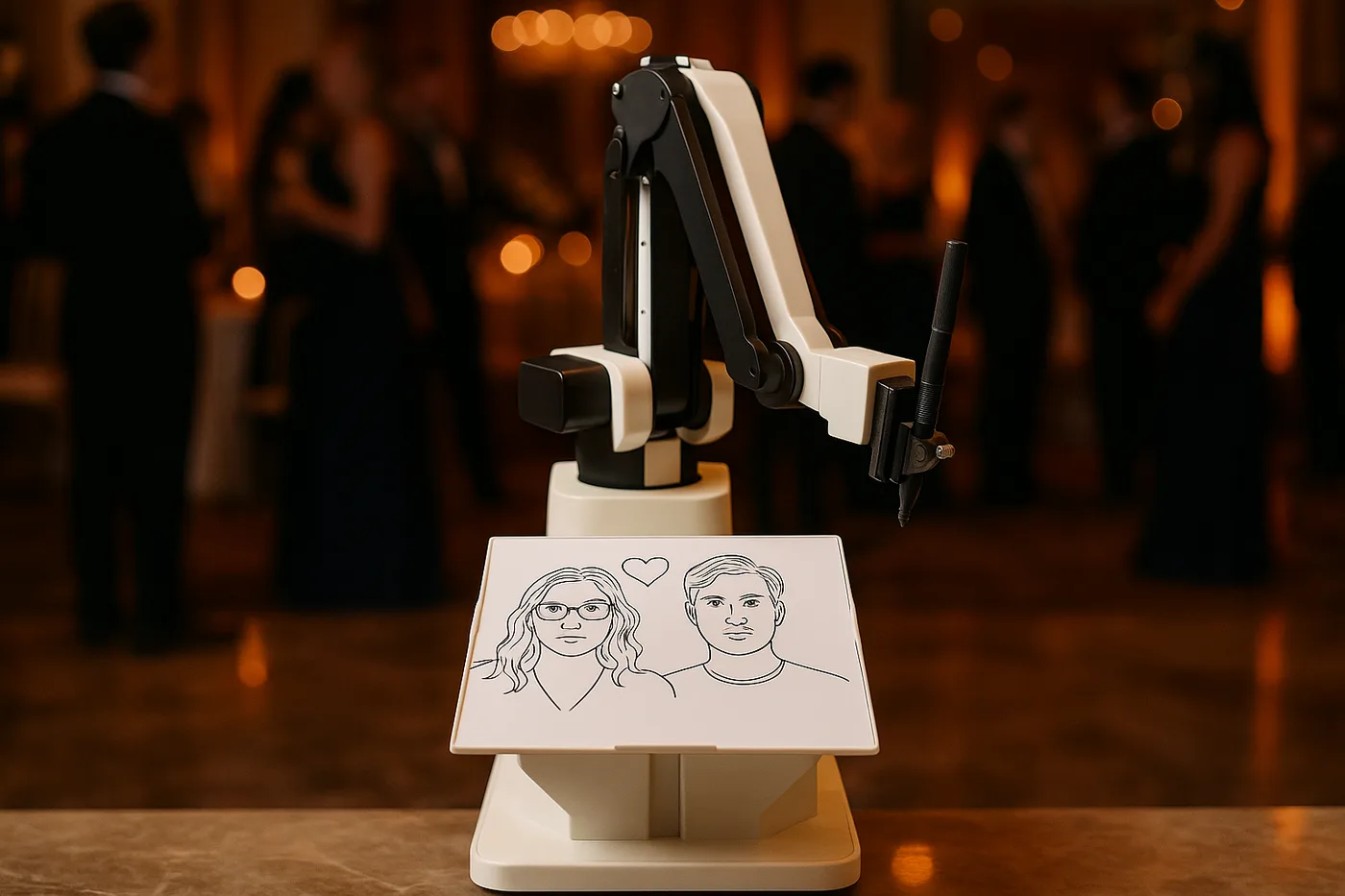
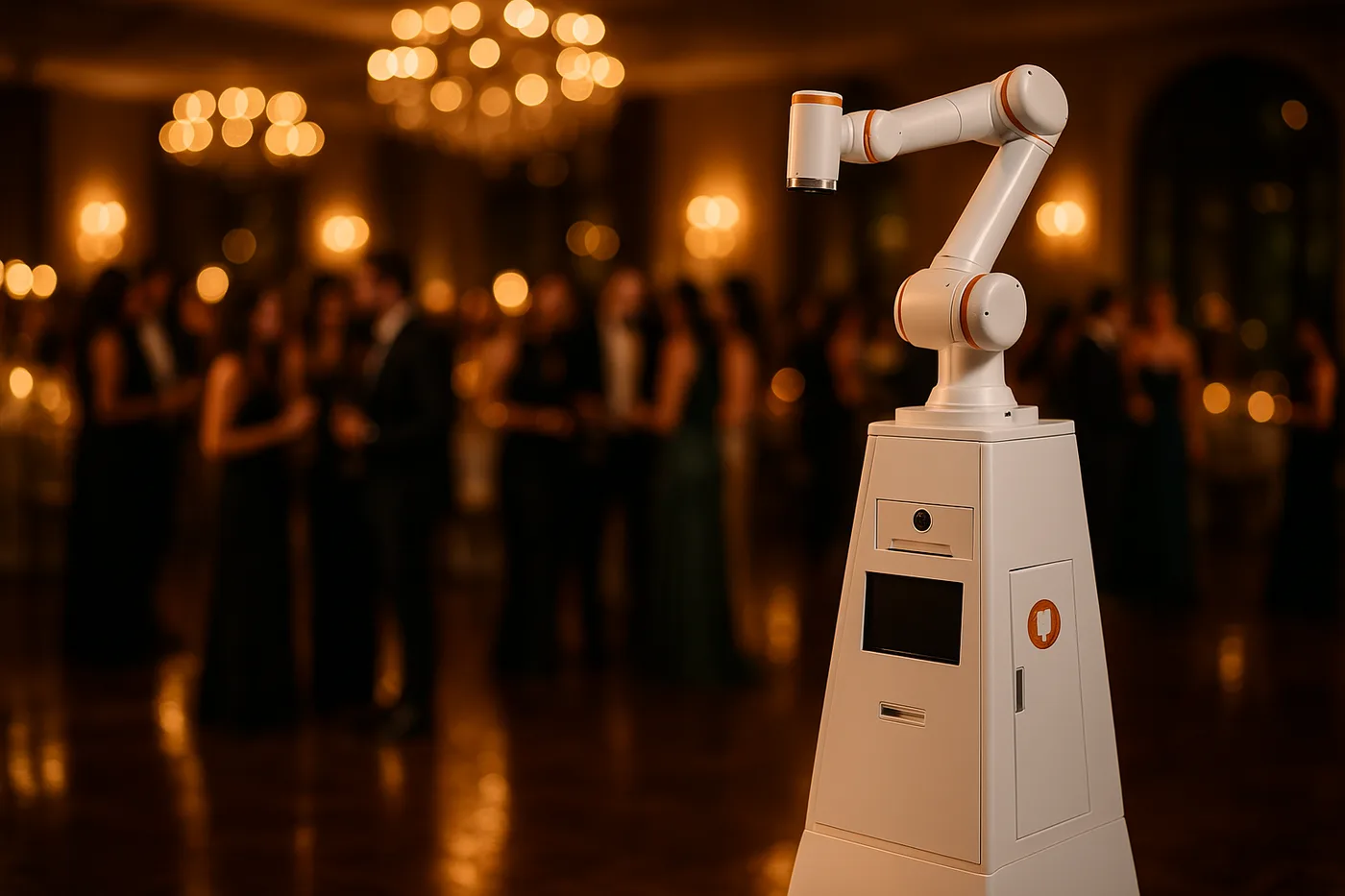
We build and sell the CaricaBot, a caricature robot that runs on PictiaX: the guest snaps a photo on their own phone, the AI analyses the face and the arm draws the portrait in pen, in one continuous line, in about 60 seconds, with a digital copy by QR or link. Each portrait uses one PICTICOIN and there is no monthly fee. It is designed for continuous high-volume flow and scales to eight robots running at the same event, from $2,490 with the PictiaX Launch Pack (two robots, a one-year licence and 500 PICTICOINS), final price on request, with a 3-year warranty.
We also sell the Glambot robot arm, which is a different product: a 6-axis arm that films slow motion rather than drawing.
And if you want the market context before buying anything, the honest comparison of the sector, us included, is in AI sketch robot comparison.
Questions to Ask Before You Buy Any Robot
Whatever you end up choosing, these five answers are worth more than a spec sheet:
1. Does the software run on other arms, or only this one? This is the lock-in question.
2. What happens when a drawing fails mid-portrait? Ask to see it, not to be told about it.
3. What is the throughput at hour six, not at hour one?
4. How does branding get applied, and does it survive a style change?
5. Does it work with no internet? Venues lose connectivity and events do not stop.
A vendor who answers all five without hedging is selling you something real.
Comparison table
| PICTIAX | Software bundled with the robot | |
|---|---|---|
| Runs on | Multiple robotic arm platforms | That manufacturer's arm only |
| Pricing model | Licence (annual or lifetime) plus PICTICOINS per portrait | Priced into the hardware |
| Second robot from another maker | Same workflow across both | A second workflow to learn and maintain |
| Branding | Logo and campaign layer | Varies, often an overlay |
| Offline | On-device plus cloud AI | Varies, often cloud dependent |
| Event reliability | Queue logic, retries, fallbacks | Varies |
| Who it is for | Operators, agencies and brands running real events | Whoever bought that specific robot |
Frequently Asked Questions
What Is PICTIAX?
The AI software that turns a robotic drawing arm into a live-portrait experience: face analysis, line generation, style engine, branding layer and the event logic that keeps it running. It is licensed separately from the hardware and runs on multiple robotic arm platforms. See pictiax.com for current licence and PICTICOIN pricing.
What Are PICTICOINS?
The credits PICTIAX runs on. One PICTICOIN is consumed per portrait drawn, covering face analysis, path generation, style application and the branded layer. You top them up as you go, so the software cost tracks how much you actually work rather than sitting as a flat fee through a quiet month.
Can I Use PICTIAX With a Robot I Already Own?
That is the point of it: PICTIAX is hardware-agnostic and runs on multiple robotic arm platforms rather than being tied to one manufacturer. Check compatibility for your specific arm at pictiax.com before buying anything.
Is the Software Really More Important Than the Arm?
For a live event, yes. Robotic arms with similar reach and repeatability are widely available and largely interchangeable. What separates a portrait guests want to keep from one they leave on the table is identity preservation, line quality and the queue logic that holds at hour six. All three are software.
Does the CaricaBot Need Separate Software?
No. The CaricaBot runs PictiaX, so it arrives as a working system: the guest takes a photo with their phone and the arm draws the caricature in pen in about 60 seconds, with support at the event and a 3-year warranty. If you are running a mixed fleet with arms from different manufacturers, a hardware-agnostic layer like PICTIAX is what keeps one workflow across all of them. Ask us and we will tell you straight which setup fits your case.
How Fast Should an AI Portrait Robot Be?
Around a minute per portrait is the working benchmark for a pen-drawn portrait, and it is what the CaricaBot delivers, so one robot covers roughly 60 guests an hour and bigger crowds call for more robots. Anything past a minute and a half and the queue becomes the experience, which is the opposite of what the client booked.
What Software Does the CaricaBot Run?
It runs PictiaX, so a CaricaBot arrives ready to draw: face analysis, line generation, the pen drawing on 10×15 or 20×15 paper and the digital copy by QR or link, with one PICTICOIN per portrait and no monthly fee, from $2,490 with the PictiaX Launch Pack (final price on request) and a 3-year warranty. If you already run arms from other manufacturers, a hardware-agnostic licence such as PICTIAX is what keeps one workflow across the whole fleet.
Is There Portrait Robot Software That Works Offline?
PICTIAX runs the AI on the device alongside the cloud, so a venue with no signal does not stop the queue. Ask any vendor this before you buy: a portrait robot that needs a connection is a portrait robot that stops at the exact venues where the booking was most expensive.
Related Guides
Need Help Choosing?
We're direct manufacturers. We'll advise you with no obligation for your case.